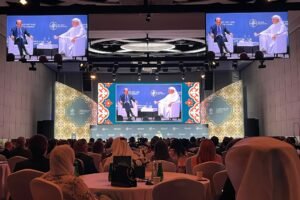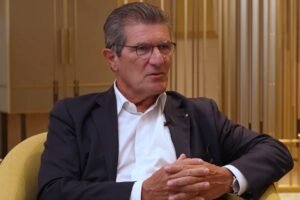









In this interview, Curtis S. Chin, Chair of the Senior Fellows and Senior Advisor for Global Markets at the Milken Institute, shares his perspective on how K-Pop evolved from a local music movement into a global cultural and economic force. Drawing on his experience across global markets, policy, and international engagement, he discusses whether a Gulf country could replicate — or reimagine — this model. From soft power and creative ecosystems to regulation, diaspora networks, and digital platforms, Curtis Chin outlines what it truly takes to build a globally scalable cultural industry.
When we talk about whether the Gulf can replicate the success of K-Pop, we have to begin with a fundamental point: Gulf countries today are in a prime position to invest in soft power and creative economies — arguably in a much stronger starting position than South Korea was in the 1980s. The capital is there. The ambition is there. But countries must put in considerable effort to make society comfortable with embracing the creative industry as a core economic sector. That shift does not happen overnight.
K-Pop’s evolution was closely tied to major societal changes in South Korea. In the late 1980s, as the country transitioned toward democracy, there was a boost in civic nationalism and renewed pride in Korean traditions. Culture, alongside politics and business, adapted to suit a modern South Korean state and lifestyle.
The Korean Wave, or “Hallyu,” actually came as a surprise even to Koreans themselves. In the mid-20th century, American movies held roughly 80 percent market share in South Korea. At a certain point, government and industry made a strategic decision to compete head-on with the United States and Japan in cultural production. That decision was bold and transformative.
In 1992, Seo Taiji and Boys — often seen as the first successful K-Pop group — blended Korean ballads with rap and rock influences. That fusion created something new and distinct. Later, geopolitical tensions such as the THAAD dispute with China led to informal restrictions on Korean content in China. Ironically, that pushed Korea to diversify its export markets beyond East Asia and think more globally.
There were also key legitimacy moments. Park Chan-wook’s film Oldboy won the Grand Prix at Cannes in 2004, marking one of the first major validations of Korean storytelling in Western media. Fast forward to today, and BTS alone has been estimated to contribute $4.65 billion to the South Korean economy — a figure larger than the entire GDP of countries such as Barbados or Fiji. That is the scale we are talking about.
Policy choices played a critical role. In the early 1990s, the government increased the budget of the Ministry of Culture and Tourism, helping expand the reach of Hallyu through cultural festivals both inside and outside Korea. Korea also effectively utilized its diaspora communities. For example, KCON launched in California in 2012 and grew from 10,000 attendees to 40,000 within just three years. The country developed an ecosystem of support through multilateral institutions such as WIPO and through a tax system that strengthened intellectual property protection.
Alignment between government, private capital, and creative talent was important — but it did not mean total state control. The South Korean Presidential Advisory Council on Science and Technology recognized the economic impact of culture in the 1990s, yet the major entertainment firms were independently created. The government did not micromanage creativity. Leaders like Miky Lee spearheaded content development in the private sector. That balance between strategy and independence was key.
Today, Korea’s creative sector grows at 4 to 5 percent annually, employs over 600,000 people, and generated $12.4 billion in export revenue in 2021. By comparison, the country’s consumer electronic equipment exports generated $4.7 billion. In tourism surveys, 31.9 percent of visitors in 2025 cited Hallyu content as their primary reason for traveling to Korea. Culture is not symbolic — it is economically measurable.
What differentiates K-Pop from previous global pop culture waves is its use of evolving mass communication and social media. During the pandemic, K-Pop strengthened online fan communities that remained constantly active. Streaming services like Netflix accelerated international reach. While Netflix often retains full rights to the content it funds — creating certain tensions — streaming has enabled rapid global expansion.
Korean storytelling also relies on universal themes such as family and relationships. The historical series Jumong reportedly reached up to 80 percent viewership in Iran in 2008, to the point that traffic would decrease when it aired. That illustrates the power of compelling narratives across cultures.
Looking at the Gulf, structural differences should be viewed as advantages rather than obstacles. South Korea’s GDP per capita in 1986 was approximately $2,910. By contrast, the UAE’s GDP per capita in 2024 stands at around $50,250. The Gulf begins with far greater financial resources. Saudi Arabia did not even have a formal film industry until 2018 — meaning there is room to build from scratch.
However, time is a critical factor. There were roughly 30 years between the introduction of Korean dramas to Japanese and Chinese markets and the Oscar success of Parasite. Building a global cultural industry is a long-term endeavor.
The Gulf can also learn from regional examples. Turkish content has achieved strong success across the Middle East, crossing cultural and language barriers. There are lessons in how regional narratives can scale.
From a global markets perspective, language is less of a barrier than it once was. Around 50 percent of Americans now watch media with subtitles. Globally, 40 percent of Netflix users always have subtitles switched on, and 80 percent use them at least once a month. Korean films have prioritized the Korean language while focusing on universal themes. Authenticity does not prevent global appeal.
Global platforms and algorithms now play a powerful role. Algorithms reinforce viewing habits — sometimes positively, sometimes negatively. The question for Gulf countries is how comfortable they are allowing content to grow organically rather than through purely top-down direction. For example, the intellectual property value of K-POP Demon Hunters has been estimated at $722 million, yet much of that value accrues to U.S. and Japanese firms. Countries must decide how much control they are willing to share.
Authenticity versus global appeal is not a binary choice. Storylines from the Gulf can resonate globally. A middle-class family in the Gulf may not be that different from one in the United States. The key question is how far countries are willing to go beyond their domestic audience and whether they are prepared to adapt certain narratives for international markets.
The biggest mistake policymakers and investors can make is trying to engineer a cultural phenomenon perfectly from the start. Creative industries require risk tolerance. Before Parasite, there were thousands of films. Failure is part of the process.
If I were advising a Gulf government or sovereign wealth fund today, I would recommend three non-obvious steps. First, secure domestic buy-in. Cultural products must be something citizens are proud of and willing to support. Second, actively engage diaspora communities abroad and invest in building cultural bridges. Third, create clear and supportive regulatory frameworks that protect intellectual property and incentivize people to pursue creative careers.
The Gulf has the capital and ambition. The real question is whether it is prepared for the long-term cultural, regulatory, and societal commitment required. With that commitment, there is no reason the next global cultural wave could not emerge from the region.